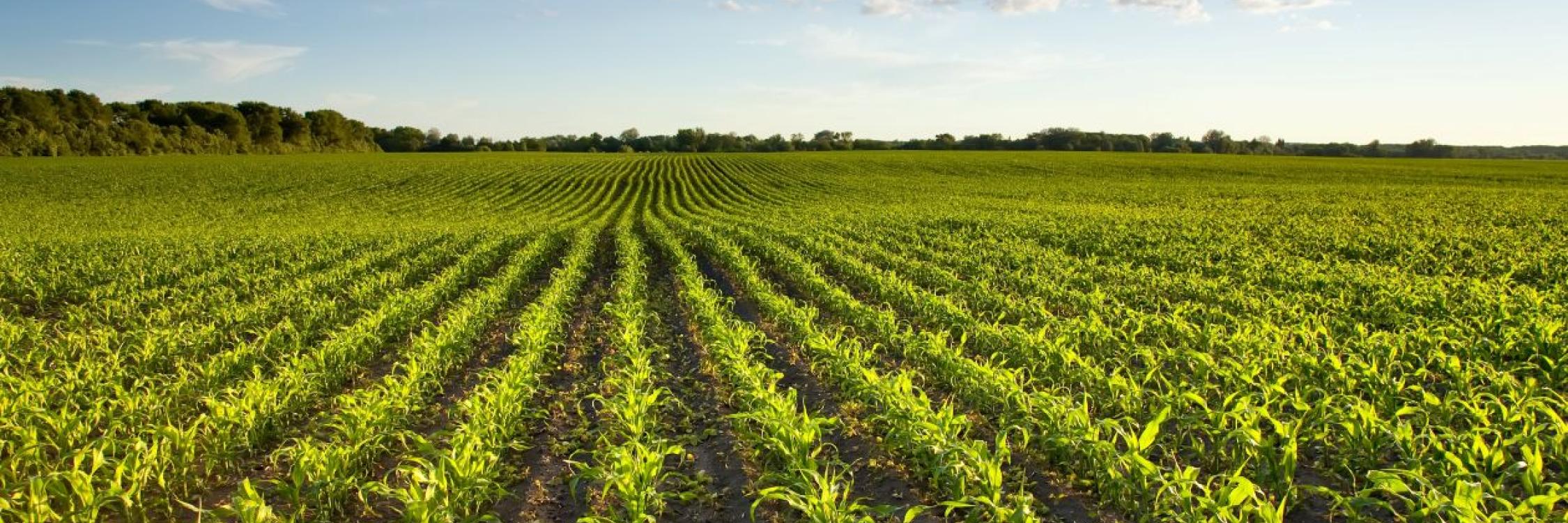
Corn
Field corn has many different uses and is particularly grown for livestock fodder (dry kernels or green fodder), and bioethanol production. The principal varieties of field maize include dent corn, flint corn, flour corn (also known as soft corn), and waxy corn. Field maize is usually allowed to mature fully before being harvested, stored and dried in silos, pits, bins, or grain "flats." It can also be harvested as high-moisture corn, shelled off the cob, and packed like silage for fermentation. Field maize is used in large-scale applications such as livestock fodder, cereal products, and various processed human-food products like corn starch, corn oil, and corn syrup. It is also used in the production of adhesives, plastics, gels, and thickeners from starch.
Field maize is quick growing, yields high biomass, and is highly palatable. It contains important quantities of protein and minerals, as well as high concentrations of soluble sugars in the green stage, which makes it highly suitable for preservation as silage. Desirable forage characteristics include high dry matter yield, high protein concentration, high energy concentration (high digestibility), high intake potential (low fiber content), and optimum dry matter concentration at harvest for optimal forage fermentation.
When deciding on a fertilizer program for field maize, several important factors need to be considered to ensure optimal yield and quality. Field maize requires a balanced supply of nutrients for healthy growth and he specific nutrient needs will be influenced by the soil type and crop variety, as well as the target yield. Factors such as rainfall, temperature, and soil texture can all influence nutrient availability and uptake
Nutritional Requirements

Nitrogen
Learn more
This in particular through its role in photosynthesis and other biological processes such as absorption of water and minerals, vacuole storage, and xylem transport. Nitrogen is a major component of amino acids, which function as the building blocks of proteins. Perhaps the major role it plays as a component of chlorophyll, that is essential for photosynthesis. Adequate N availability in corn allows the plant to reach its genetic yield potential.
A slight lack of nitrogen is much less damaging than an excess of nitrogen. Nitrogen fertilization input can be calculated using the balance method. An excess of nitrogen fertilizer will result in an overdevelopment of the vegetation and this could potentially delay grain filling. For nitrogen fertilization it is preferable to favour a fractionation in 2 or 3 applications in order to avoid the excesses that are associated with a single application (leaching and excessive incorporation). A more gradual entry of nitrogen into the plant also helps reduce the risk of some diseases.
N availability is dependent on many complex and interacting factors, including:
- initial N application rates and timing.
- mineralization of soil organic matter, which provides N in plant-usable forms.
- environmental factors that affect volatilization, leaching, denitrification and mineralization.
- crop uptake during the vegetative period.

Phosphorus
Learn more
Adequate P for corn results in increased root growth, greater stalk strength, improved crop quality, uniform and earlier crop maturity, and higher grain production. Because of the very low mobility of phosphorus and soil fixation (retrogradation) placement of fertilizer, P can affect its availability to plants especially in early growth stages.
Phosphorus must be delivered in a localized manner as this will favor a rapid development of the root system. Orthophosphate forms that are immediately assimilable are preferred. For the polyphosphate forms, the chemical properties of the soil (pH and cation contents) will be decisive either for the transformation of phosphorus into assimilable forms or, on the contrary, for the blocking of the phosphorus, in particular by iron, aluminium or calcium.

Potassium
Learn more
It functions as an activator for many enzymes and metabolic pathways, including those for photosynthesis and protein and starch formation in grain. Potassium plays a role in the flow of water, nutrients, and carbohydrates within the plant. It plays a role in the regulation of stomata closing and opening, thus impacting the exchange of water and gases.
Potassium is also a key element in terms of improving the resistance of plants against frost and drought and against diseases. Potassium chloride and nitrate fertilizers can suffer leaching, particularly when they are applied prior to planting of the crop.
It is important to understand the cation exchange capacity (CEC) of the soil in order to supply the correct quantities and ratios of nutrients. Furthermore, chloride competes with nitrates and promotes the development of soft tissue. In the field, one can expect potential issues relating to salinity in cases where there is low rainfall.

Sulfur
Learn more
It is essential for the synthesis of sulfur-containing amino acids, influences overall protein synthesis and therefore has a positive effect on yield. An optimal sulfur supply leads to efficient nitrogen utilization. This is because in the case of sulfur deficiency, the nitrogen taken up cannot be converted into proteins and a signal is sent to the roots to take up less nitrogen. Thus, to make optimal use of nitrogen, the plant's need for sulfur must be met.
Sulfur enables the corn plant to maintain its physiological processes optimally even under drought stress and to avoid or at least minimize yield losses. Sulfur is a component of the metabolic product glutathione, which, as an antioxidant, renders oxygen radicals formed during drought stress harmless and therefore prevents necrosis of the leaves.
Nowadays, sulfur deficiencies are increasingly observed due to the significant reduction in the atmospheric deposition of sulfur. It can be provided in the elemental, sulphate or thiosulfate forms.

Calcium
Learn more
In order to optimize yield and quality, calcium must be readily available in the soil near roots. Calcium is part of every plant cell. Without adequate Ca, cell walls would collapse and plants would not remain upright. Calcium is not mobile in plants. It does not easily move from old leaves to young leaves.
Calcium also has a positive effect on soil properties. This nutrient improves soil structure thereby increasing water penetration, and providing a more favorable soil environment for growth of plant roots and soil microorganisms. It plays an important part in regulating acidity.
Calcium leads to greater root mass and faster, better growth in spring. It also helps promote plant uniformity, a key factor among row crop and forage growers. As sulfur , calcium is also a key nutrient for nitrate reductase enzyme in the leaves to rule the transformation of nitrate to ammonium and amino acids. Calcium play an important role in nitrogen efficiency.

Magnesium
Learn more
Therefore, it is essential for photosynthesis. As might be expected, plants that are deficient in magnesium have an overall light green colour. In corn, the veins are mainly white when concentrations are inadequate. A supply of magnesium is often beneficial in poorly supplied soils or in the case of significant potassium uptake. Magnesium must be accompanied by zinc, manganese and boron, which become less available in soils with a basic pH (>7). In some cases, foliar inputs from the beginning of the growth are justified.
These four elements are involved in the development of the leaf mass and they have a subsequent impact on the quality of grain development and filling. They must be available from the beginning of growth in order to fully play their role. It is important to maintain a K/Mg ratio of approximately 3/1 in the soil.
Our Solutions
Contact your local sales representative for tailored recommendations

Thio-Sul®
Learn more
Thio-Sul® is the original liquid ammonium thiosulfate fertiliser, supplying 12% nitrogen (N) and 26% sulfur (S) in a clear, stable solution.
Each litre of Thio-Sul provides approximately 160 g of nitrogen and 346 g of sulfur, delivering a concentrated and efficient source of both nutrients. Its liquid formulation is easy to handle and integrates readily into modern crop nutrition programmes across a wide range of crops and production systems.
By supplying nitrogen and thiosulfate sulfur together, Thio-Sul helps maintain an appropriate nitrogen-to-sulfur balance, supports protein formation and promotes more efficient use of applied nitrogen. Its sulfur becomes available progressively as thiosulfate is converted in the soil, helping support crop nutrition throughout key growth stages.
Thio-Sul can be applied through irrigation systems, banded, broadcast, injected into the soil or incorporated into compatible liquid fertiliser blends. This application flexibility makes it a practical solution for improving sulfur nutrition and complementing nitrogen fertilisation.

P-Sure®
Learn more
By combining both orthophosphate and polyphosphate phosphorus, P-Sure delivers immediately available phosphorus while maintaining phosphorus availability after application. Its excellent physical stability, low salting-out temperature and long storage life make P-Sure an ideal foundation for modern liquid fertilizer programmes.
P-Sure promotes rapid root development, vigorous early crop establishment and efficient nutrient uptake during the critical stages of plant growth. The polyphosphate fraction also helps maintain the availability of micronutrients such as zinc, iron and manganese, supporting balanced nutrition and improved crop performance.
P-Sure is highly compatible with many liquid fertilizers, except calcium-containing products, and is ideal for starter fertilizers, fertigation and custom liquid blends. It combines particularly well with KTS® to produce efficient liquid NPKS formulations, providing growers with a flexible solution for precision crop nutrition.

KTS®
Learn more
Each litre of KTS supplies approximately 360 g of potash and 252 g of sulfur, providing a highly concentrated source of soluble potassium and sulfur. Its nitrate-free and chloride-free formulation allows potassium to be supplied without adding unnecessary nitrogen or chloride.
Potassium supports water regulation, enzyme activity, carbohydrate transport and the development of crop yield and quality, while sulfur contributes to protein and enzyme formation. KTS is particularly valuable during periods of rapid growth, reproductive development and crop filling, when potassium requirements can increase substantially.
KTS can be used through fertigation, in starter or side-dress programmes, in compatible liquid fertiliser blends and as a foliar treatment on selected crops. Its versatility allows potassium and sulfur to be delivered at critical stages within a wide range of crop nutrition programmes.

CaTs®
Learn more
Each litre of CaTs supplies approximately 75 g of calcium and 125 g of sulfur, providing both nutrients in a fully soluble liquid form. CaTs combines crop nutrition with soil-management benefits and can be incorporated into a broad range of fertilisation programmes.
Calcium contributes to cell-wall strength, root development and the structural integrity of growing plant tissues, while sulfur supports protein and enzyme formation. A consistent calcium supply is especially important during periods of rapid vegetative growth and fruit development, helping support crop quality, firmness and marketability.
CaTs can be applied through irrigation systems, banded, broadcast or blended with compatible liquid fertilisers. It may also be used as a soil amendment to provide soluble calcium, support soil aggregation and water infiltration, and help manage the effects of excess sodium in saline or sodic soils.

K-Leaf®
Learn more
Its fine crystalline formulation dissolves rapidly and completely, producing a clean spray solution with minimal residue. This makes K-Leaf particularly suitable for precision spraying and for situations in which crops require a rapid supplementary supply of potassium and sulfur.
Applied directly to the foliage, K-Leaf helps prevent or correct potassium and sulfur deficiencies during critical growth stages. Potassium supports water regulation, photosynthesis, carbohydrate movement and crop quality, while sulfur contributes to protein synthesis and essential metabolic processes.
K-Leaf can supplement soil fertilisation when nutrient uptake through the roots is restricted or when crop demand temporarily exceeds soil supply. It is suitable for a wide range of broad-acre, fruit and vegetable crops and can be combined with many compatible soluble fertilisers and crop-protection products following a compatibility test.

GranuPotasse®
Learn more
The chloride-free, nitrogen-free formulation of GranuPotasse provides an efficient source of potassium and sulfur, making it ideal for chloride-sensitive crops and high-value production systems. The uniform, free-flowing granules ensure accurate spreading, easy handling and consistent field performance.
By supplying potassium and sulfur in readily available forms, GranuPotasse supports water regulation, enzyme activation, carbohydrate transport and protein synthesis, helping improve crop yield, quality and marketability. It is particularly beneficial for fruit, vegetable and other high-value crops where crop quality, storage life and export potential are essential.
GranuPotasse® is suitable for pre-plant, basal and in-season applications and can be broadcast, banded or incorporated into the soil. It also blends readily with many granular fertilizers, providing growers with a flexible solution for balanced potassium and sulfur nutrition across a wide range of cropping systems.
Additional Information
-

Resources
Find recommendations and usage guidelines for our fertilizers
-
-

Contact us
Get the answers you need to product information, field trial results, blend testing, application tips and more. Find and contact your local expert in your region.
